AI Agents That Pay: How Machine Payments Work and What to Build

AI agents can now pay for APIs, data and services on their own with stablecoins and HTTP 402. Here is how agent payments work and what businesses should build.
Today, most AI agents can do almost everything except pay. They search, compare, fill in forms and add products to a cart. Then a person takes over to enter a card number.
That is starting to change. In 2026, the pieces for agents that pay on their own have arrived: payment standards built into the web itself, stablecoins that settle in seconds, and wallets an agent can hold.
We build AI products and payment products, so this is where our two worlds meet. This post covers how agent payments work, what can go wrong, and what we think businesses should build now.
From Agents That Shop to Agents That Pay
We see the gap every day in our own work. Totebot, our AI shopping agent platform, helps customers find products in Shopify stores and keeps their cart in sync as they talk to it. It can do everything up to checkout. At checkout, a human still pays.
For shopping, that is fine. A person wants to approve the purchase anyway. But a lot of what agents need is not shopping. It is a dataset for one question, one call to a paid API, ten minutes of compute, a single article behind a paywall. Nobody wants to sign up, add a card and pick a monthly plan for a request that costs a cent.
Card payments were built for people and for amounts worth the fees. Agent payments need something else: tiny amounts, no account, settled instantly, paid by software.
How Agent Payments Work: HTTP 402 and Machine Payments
The web has had a status code for this since the 1990s. HTTP 402, "Payment Required", was reserved and never really used. Two open standards now give it a job.
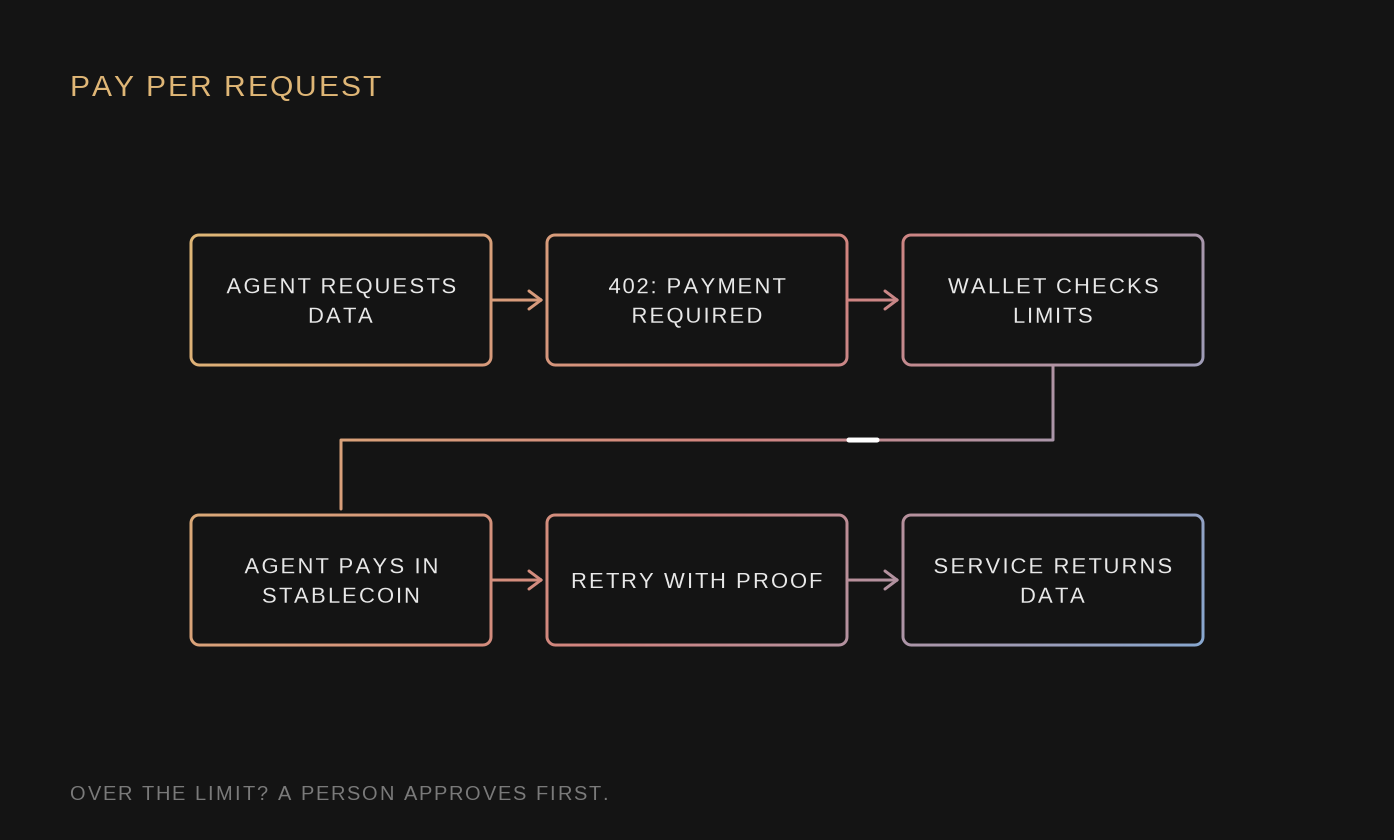
x402. Started by Coinbase and now run by the x402 Foundation under the Linux Foundation. A server answers a request with 402 and a price. The agent pays in stablecoins and sends the request again with proof of payment. No account, no API key, no subscription.
The Machine Payments Protocol (MPP). Launched in March 2026 by Stripe and Tempo, the payments blockchain Stripe incubated, together with Tempo's mainnet. It uses the same 402 pattern, but is not tied to one kind of money: stablecoins, cards and other methods can all sit behind it. It also adds sessions. An agent sets money aside up front, pays as it uses a service, and the many small payments settle together instead of one by one.
The details differ, but the idea is the same. Payment becomes part of the request, the same way authentication is. For a developer, that turns "set up billing" into a few lines of code.
Why Stablecoins Fit Machine Payments
Agents could pay with cards, and some will. But for small, frequent, automatic payments, stablecoins have real advantages.
Tiny amounts work. A card payment for one cent makes no sense once fees are counted. A stablecoin transfer on a cheap network costs a fraction of a cent.
Settlement is final in seconds. The service knows it has been paid before it answers. There is no chargeback window and no invoice to chase.
No account needed. A wallet is enough. An agent does not need to pass a sign-up form built for humans.
The business side of stablecoins still applies when the payer is software: you need ramps to and from bank money, compliance checks and clean accounting.
The Hard Part: Spending Limits, Approvals and Accountability
Giving an agent a wallet is easy. Deciding what it is allowed to do with it is the real work.

Wallets built for agents
An agent should never hold the company treasury's keys. It gets its own wallet, funded with a small amount, topped up by a separate process. If something goes wrong, the most you can lose is what is in that wallet.
Smart contract wallets and MPC wallets make this practical. Limits can be enforced by the wallet itself, not only by the agent's prompt. A rule written in a prompt is a suggestion. A rule enforced by the wallet is a limit.
Limits and approvals
The controls that work are the boring ones finance teams already use:
- A limit per request and a budget per day.
- An allowlist of services the agent can pay.
- Human approval above a threshold, or for any new payee.
- A kill switch that freezes the wallet instantly.
The pattern is the same one we use with our own coding agents, which we wrote about in giving AI agents permissions without giving them the keys. Agents work within clear permissions. Anything that touches money is high risk by default and goes to a person. Speed comes from automating the low-risk cases, not from removing the checks on the high-risk ones.
Fraud and accountability
New payment rails bring new tricks. A malicious page can tell an agent to pay it. A fake service can charge for data it never delivers. A loop can spend a budget in minutes.
Assume the agent can be fooled. Treat anything it reads on the web as untrusted, and never let content from a page decide where money goes.
Log everything. Every payment should record which agent paid, for which task, on whose behalf, and what came back. When something goes wrong, "the agent did it" is not an answer a customer or a regulator will accept. Someone in the business owns every agent and everything it spends.
What Businesses Should Build Now
There are two sides to this, and most businesses will end up on both.
If you sell data, APIs or content, make it buyable by agents. Agents are a new kind of customer, and today most products turn them away at the sign-up page. A pay-per-request option alongside your normal plans lets agents use your product without a sales call. Start with one endpoint and a fixed price per call, and see who shows up.
If you run agents, give them a budget, not a credit card. Separate wallets, hard limits, approvals and a full log, before the first payment goes out. These controls are much easier to design in than to add after an incident.
Keep humans where they matter. Buying a one-cent API call does not need a person. Signing a contract, paying a new supplier or moving large amounts still does. The design work is drawing that line clearly and enforcing it in code.
This is where AI and payments engineering meet, and it is exactly the kind of system we enjoy building: an agent that does real work, on rails that move real money, with checks that make it safe to let it run.
The Agent Economy Needs Guardrails
Agents that pay are coming whether businesses prepare or not. The standards are live, the money moves in seconds, and the first services already accept payments from software.
The businesses that do well will be the ones whose agents can spend, but only within limits they chose on purpose.