Systems of Intelligence in Finance Ops: Where AI Fits in the Back Office

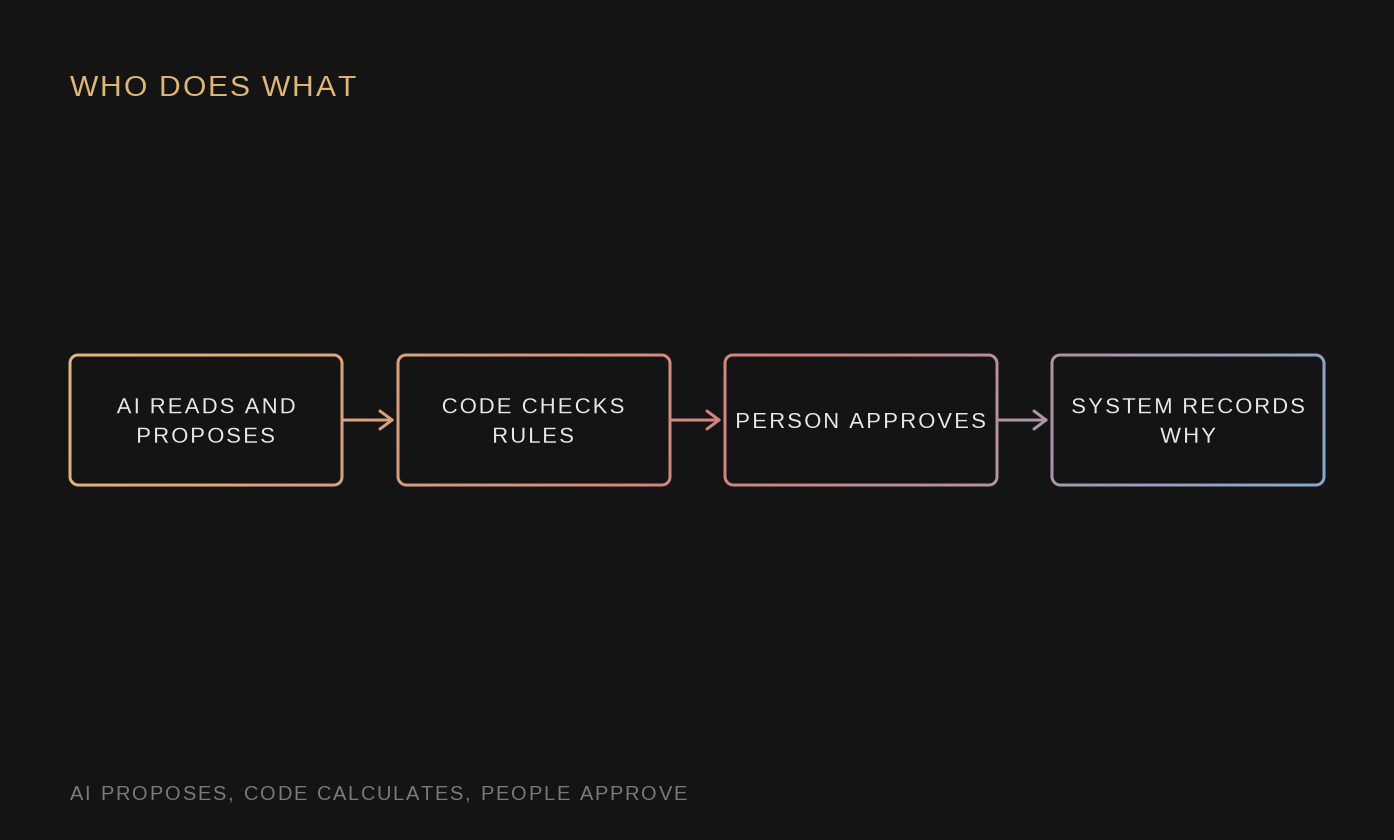
- The Rule: AI Proposes, Code Calculates, People Approve
- Reconciliation: Matching the Messy Middle
- Invoice and AP Processing: From Inbox to Approved
- Approvals: Routing With Precedent
- Month-End Close: Fewer Late Nights
- Exception Handling: Where the Real Value Is
- Reporting: Answers With Sources
- What Has to Be True Before You Start
Where AI fits in finance back-office work: reconciliation, invoice processing, approvals, month-end close, exceptions and reporting, and where to keep it out.
In Systems of Record vs Systems of Intelligence, we argued that most business software records what happened but not why. Finance operations is where that gap costs the most.
Your ERP knows an invoice was paid. It does not know why it was approved despite a price mismatch, who checked the contract, or which past case set the precedent. That reasoning lives in email threads, spreadsheet comments and the heads of two people who have been on the team for years.
On our AI Solutions page we put it simply: "We enable banks and fintechs to automate workflows, improve fraud detection, and create smarter, more responsive customer experiences." This post is about the first part of that sentence, applied to the back office. Where AI genuinely helps, and where it should stay out.
The Rule: AI Proposes, Code Calculates, People Approve
Before going workflow by workflow, one principle covers all of them.
AI is good at reading messy inputs. Invoices in fifty layouts, bank references with typos, vendor emails, free-text notes. It turns them into structured data and makes a good guess about what goes with what.
Code is good at arithmetic and rules. Totals, tax, currency conversion, matching tolerances and posting logic belong in deterministic code that gives the same answer every time.
People own the decisions that move money. The AI suggests, the system checks, and a person with the right authority approves. Every step is recorded.
Keep these three roles separate and AI becomes a safe, fast assistant to your finance team. Mix them up and you get a confident model posting journal entries nobody can explain.
Reconciliation: Matching the Messy Middle
Bank reconciliation is the classic back-office grind. Rule-based matching already handles the easy cases: same amount, same reference, same day. The work is in everything else.
AI handles the fuzzy matches. One payment covering three invoices. A reference with a typo. A customer paying from a parent company's account. A model can read the remittance note, the email that came with it and the open invoices, and propose a match with its reasoning.
People confirm, the system remembers. The accountant accepts or corrects the match. That decision, with the reason, is stored. Next time the same customer pays the same way, the system already knows the pattern.
This is the system of intelligence idea in practice. The value is not that the AI matched one payment. It is that the team's judgement stops disappearing after every month-end.
Invoice and AP Processing: From Inbox to Approved
Accounts payable often starts with a shared inbox full of PDFs.
Extraction. AI reads the invoice whatever its layout and pulls out supplier, amounts, tax, line items and payment terms. Code then validates the totals and checks the supplier against your vendor list and bank details on file.
Matching. The invoice is compared with the purchase order and the goods receipt. Small differences inside your tolerance pass. Larger ones become exceptions, with the AI explaining what does not match and why it might be.
Coding. The AI suggests the general ledger account and cost centre based on how similar invoices were coded before. The suggestion shows its evidence, so the reviewer can check it in seconds.
A changed bank account is never a suggestion. Fake supplier bank details are a classic route for invoice fraud. They should always trigger a separate verification step outside the AI flow.
Approvals: Routing With Precedent
Approval chains in most companies are a mix of written policy and unwritten habit.
Route by policy, explain by precedent. Code applies the approval matrix: amount limits, departments, segregation of duties. AI adds context for the approver: what this vendor usually charges, what was approved last time, and anything unusual about this request.
Approvers decide faster with better context. Instead of opening four systems, the approver sees a short summary with links to the source documents. They still click approve. They just do it with the full picture.
Month-End Close: Fewer Late Nights
The close is a long checklist where a few steps always take longer than they should.
Track the checklist. An assistant can follow close tasks across the team, chase missing inputs and flag what is blocking the next step.
Draft variance explanations. When a cost line moves more than expected against budget or last month, the AI pulls the underlying transactions and drafts an explanation. The controller edits and signs off. Writing from a draft is much faster than writing from a blank page.
Leave the entries to the people who own them. Accruals and adjustments can be prepared with AI help, but posting them stays with the accountant who is accountable for them.
Exception Handling: Where the Real Value Is
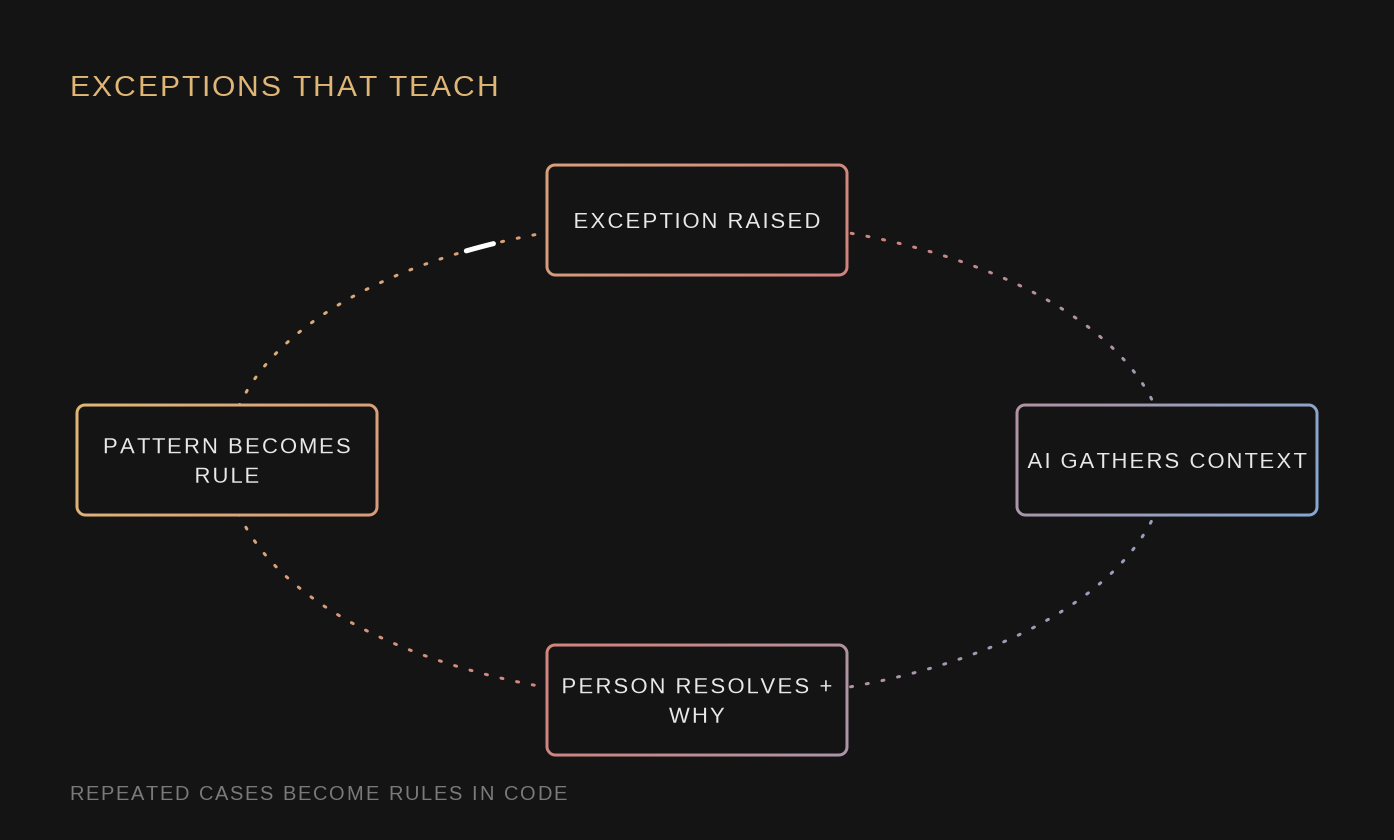
Every workflow above ends in exceptions. The unmatched payment, the invoice without a PO, the approval that falls between two policies. This is where finance teams spend most of their time, and where knowledge is lost most often.
Collect the context automatically. When an exception is raised, the system gathers what a person would look up: the documents, the history with this counterparty, similar past exceptions and how they were resolved.
Record the resolution and the reason. The person who resolves it adds a line on why. Over time this becomes a searchable record of how your company actually handles edge cases.
Turn repeated exceptions into rules. When the same exception is resolved the same way ten times, it is a candidate for a rule in code, reviewed and approved by the finance owner. That is how the volume of exceptions goes down instead of up.
Reporting: Answers With Sources
Finance teams get the same questions every week. What did we spend on contractors last quarter? Why is this cost centre over budget?
Plain-language questions, traceable answers. An AI assistant can answer from your finance data, but only if every number links back to the transactions and reports it came from. An answer without a source should not be trusted in finance, however fluent it sounds.
Commentary, not calculations. Let the reporting system compute the figures. Let the AI draft the narrative around them for the monthly pack.
What Has to Be True Before You Start
Permissions match your finance controls. The assistant sees only what the user is allowed to see, and segregation of duties holds inside the AI flow as well as outside it.
Everything is logged. Every suggestion, every acceptance, every correction. Auditors will ask, and "the AI decided" is not an answer.
Start with one workflow. Pick the one that eats the most hours and has the clearest data, usually reconciliation or invoice intake. Get it working end to end before adding the next.
We build AI systems that sit inside real workflows, not next to them. In finance operations, that means the AI does the reading and the remembering, code does the maths, and your team keeps every decision. The back office does not need a robot accountant. It needs a system that never forgets why.