Building a Prediction Market: The Hard Parts

Building a prediction market means solving liquidity, oracle resolution, indexing, honest volume and regulation. Here are the hard parts and how we handle them.
A prediction market lets people trade on outcomes: an election, an interest rate decision, a football match. Each share pays $1 if the event happens and $0 if it does not, so a share trading at 62 cents reads as a 62% chance.
The idea is simple. Building one that people trust is not.
We have built marketplaces with auctions, offers, signed orders and custom indexers, most visibly an NFT marketplace. Many of the hard parts of a prediction market are the same problems in a different shape. A few are completely new. Here is how we think about each of them.
Market Design: Order Book or AMM
There are two main ways to match buyers and sellers, and the choice shapes everything else.

An order book works like a stock exchange. Traders post the prices they want, and trades happen when a buyer and seller agree. In busy markets this gives the best prices. In quiet markets it gives an empty screen, because nobody is quoting.
An automated market maker (AMM) prices shares with a formula and always has a price. That makes it a good fit for long-tail markets nobody would make a market in by hand. The cost is a subsidy someone has to fund, and worse prices on large trades.
The largest crypto prediction markets use a hybrid order book. Orders are signed off-chain and matched by a backend, and only the final trade settles on-chain. That makes placing and cancelling orders free and instant. It is the same model we used on that NFT marketplace, where listings, offers and bids are off-chain signatures that a smart contract settles when a trade happens. We described that setup in detail in the tech side of NFT marketplaces.
Under either model, the core rule is the same: one YES share plus one NO share is always worth exactly $1. Users lock $1 of collateral to create a pair, and redeem the winning side when the market resolves. Everything in the contracts follows from that rule, and it is the part we would audit hardest.
Pricing and Liquidity
An empty market is a dead market. Nobody trades where there is no price, and nobody quotes where nobody trades.
Plan for the cold start. New markets need seeded liquidity, from the platform itself or from market makers with an agreement in place. Budget for it the way you would budget for marketing, because that is what it is.
Thin markets are easy to move. A few hundred dollars can swing a quiet market by twenty points, and people will screenshot that price as if it were the truth. Show depth and spread in the interface, and be honest about how much money stands behind a number.
Incentives attract the wrong traders. Rewards for trading volume get you volume, and very little else. If you pay for liquidity, reward orders that sit in the book near the market price, not trades that go back and forth.
Oracle and Resolution Design
This is the hardest part, and the one most teams leave until last.
Every market ends with the same question: what actually happened? Someone has to answer it, and everyone who lost money will check their answer.
Centralized resolution means the platform decides, based on published rules and sources. It is fast and clear, and it is how regulated exchanges work. Users have to trust the operator.
Optimistic oracles let anyone propose an outcome with a bond. If nobody challenges it within a window, it is final. If someone does, token holders vote. This is open, but disputes are slow, and the outcome depends on who holds the votes.
The weak point is usually the wording, not the mechanism. In July 2025, a market with tens of millions of dollars riding on whether Ukraine's president would wear a suit ended in a disputed vote because nobody had defined what counts as a suit.
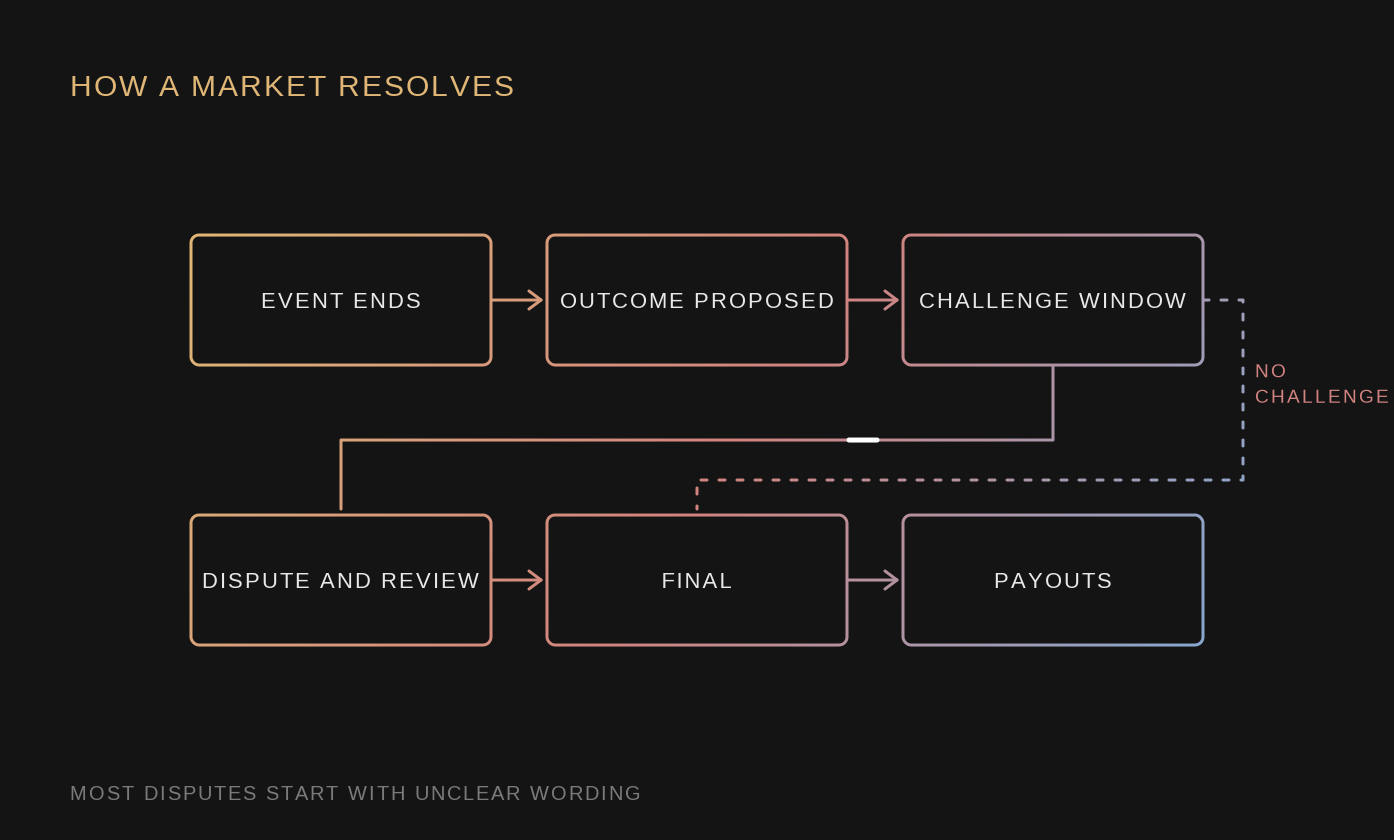
Writing the rules is product work. Name the exact source, the deadline and the time zone. Decide in advance what happens if a match is postponed, a source disappears or the question turns out to be ambiguous. Have an "invalid" outcome that returns money fairly, and pay out only after the result is final.
Indexing and Real-Time Data
Traders expect live prices, an order book that updates as they watch, and positions and profit that are always right. That data comes from two places, and they rarely agree at the same moment.
The matching engine knows a trade happened instantly. The blockchain confirms it seconds later, and occasionally reorganises a block and changes its mind. The interface has to show both states honestly: matched, then settled.
We learned this on the NFT marketplace. We built the first version on TheGraph, and now we run custom indexers on all our projects. We keep the indexer as a separate service with its own database, deterministic enough that we can drop everything and rebuild from the chain. When numbers look wrong, rebuilding is the fastest way to prove whether the bug is in the data or in the code.
Honest Volume Metrics
Prediction market volume is one of the most misleading numbers in crypto.
Wash trading inflates it. A Columbia University study from November 2025 estimated that about a quarter of Polymarket's volume over three years came from wash trading: linked wallets trading with each other to inflate activity.
Double counting doubles it. Every trade has two sides, and on-chain events record both. Sum them naively and every trade counts twice. At the end of 2025, Paradigm showed that several analytics dashboards did exactly that.
Define your metrics on day one: one-sided volume, open interest, and active traders with linked wallets grouped together. Publish how you count them. Investors, partners and regulators will run their own numbers, and you want yours to match.
Regulation and Geo-Restrictions
Talk to lawyers before you write code. Where you can operate decides what you can build.
In the US, regulated exchanges like Kalshi offer event contracts under federal commodities rules, while several states argue that sports contracts are gambling. In April 2026 a federal appeals court sided with Kalshi against New Jersey, but other cases are still open. In Europe, most countries treat prediction markets as gambling, and regulators in places like Romania have put crypto prediction markets on their lists of illegal gambling sites.
What that means in the product:
- Identity checks and sanctions screening before anyone deposits.
- Geo-restrictions based on verified residence, not just IP address.
- Market categories as configuration. Sports, elections and finance may be allowed in one country and banned in the next. That should be a setting per market and per region, not code you rewrite.
UX for People Who Don't Hold Crypto
Most people who want to bet on an election have never held a crypto wallet, and they should not have to.
That means sign-in with email, a wallet created in the background, card payments in, and balances shown in dollars or euros. Users should never see gas fees or a token approval. If wallets are new to your users, our crypto wallet 101 explains what is going on under the hood.
Show prices as chances and payouts as money: "€10 on YES pays €16 if it happens." Tell people when the market closes, how it resolves and when they get paid. Every unclear rule turns into a support ticket on resolution day.
If you are planning a prediction market or another trading product, this is the kind of work our blockchain team does from the first architecture session.
The Parts Nobody Screenshots
The trading screen is the part everyone sees, and the easiest part to build.
A prediction market lives or dies on the parts underneath: who decides what happened, whether the numbers are true, and who is allowed to trade. Get those right first. The screen can wait a week.