How We Built Čičamiča: AI Storybooks Made for One Child

How we built Čičamiča, personalised children's books written and illustrated by AI: consistent characters, age-appropriate plots and people with the final say.
We built Čičamiča for our own kids first.
We looked at personalised children's books and kept finding the same thing: one book for everyone, with a different name dropped into the same sentences. Our kids noticed. We wanted a story that was really about them, with their pets, their grandparents, their favourite toys and their way of seeing the world. And we wanted to give it to them as a real printed book, a one-of-one present nobody else has.
So we built it. Čičamiča writes and illustrates a unique storybook for every child and prints it on demand. You can see the whole product in our Čičamiča case study. This post is about the hard parts.

Why Personalised Books Are Hard to Get Right With AI
Asking a model for a bedtime story takes one prompt. Getting a book a parent will pay for, read aloud and keep on the shelf takes a lot more. Four problems kept coming back.
Natural language, whatever the story. A story about a dragon at the seaside and a story about a first day at kindergarten both have to read aloud naturally, with the child's name correct in every sentence.
Consistent scenes and characters. The child has to look like the same child on every page and on the cover. So do the grandmother, the dog and the red bicycle.
A plot that makes sense, for this age. A three-year-old and an eight-year-old need very different stories. Both need a beginning, a middle and an end that actually connect.
Safe, every time. Whatever a parent types into the wizard, nothing inappropriate can reach a child.

Writing a Story That Makes Sense
The first thing we learned is that one prompt, one story does not work. Left alone, a model writes its most predictable idea, every time.
So the story is written in stages, by three different agents.
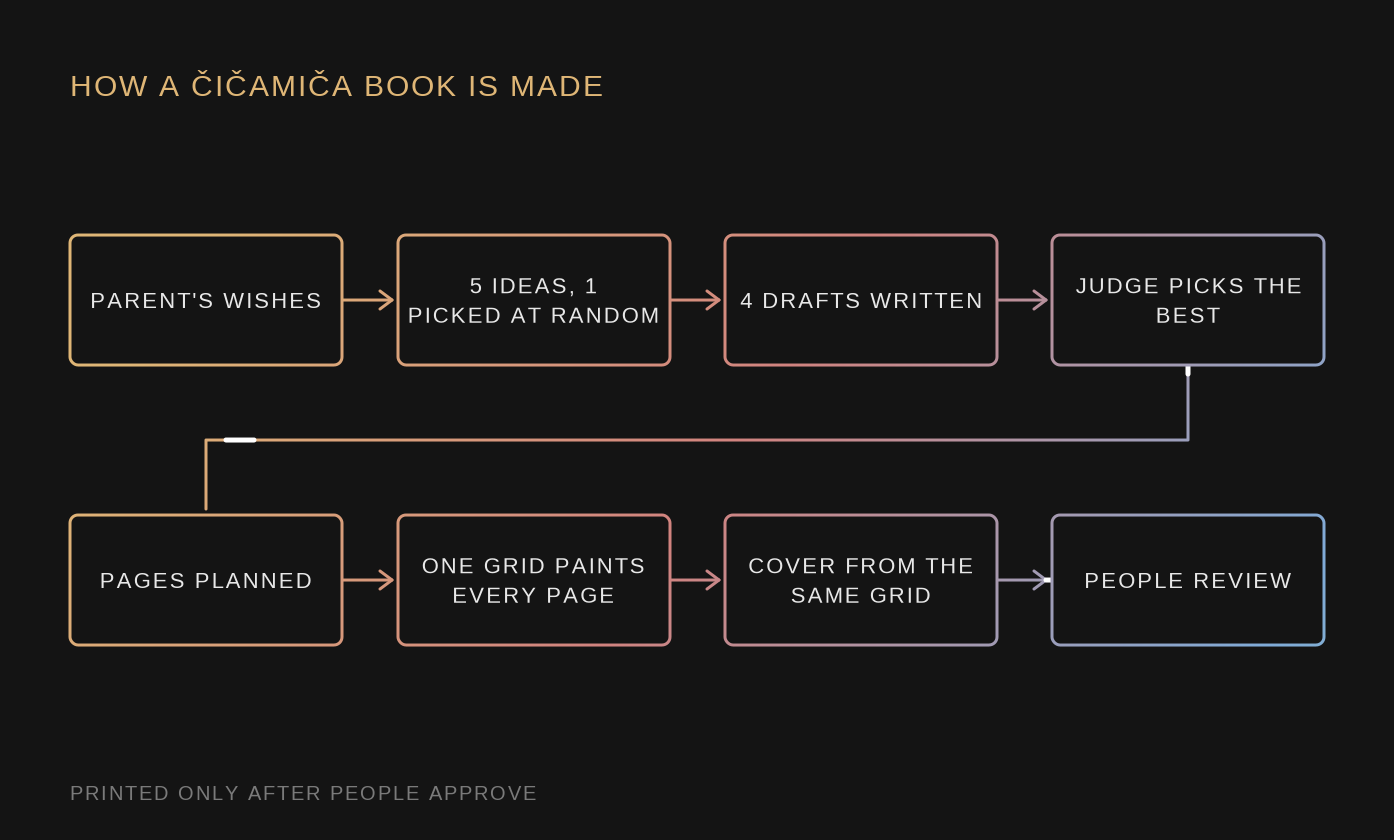
Five starting points. The first agent reads the parent's wishes and proposes five different ways the story could begin, each with what the child will understand by the end and the unexpected thing that makes it memorable.
Picked at random, on purpose. The code, not the model, picks one of the five. When a model chooses, it picks the most conventional option. Randomness is how the stories stay surprising.
Four drafts in parallel. A second agent writes four complete versions of that story at once, each sized for the child's age band: from very simple sentences for the youngest children to richer plots, humour and more characters for older ones.
A separate judge. The drafts are shuffled so their order carries no bias, then a third agent ranks them against the parent's brief, the age, how a good story is built, and the safety rules. The best one wins and is printed exactly as written.
Before the judge sees anything, plain code throws out drafts that would not print well, like a title too long for the cover. Some checks are better done by code than by a model.
Keeping Every Page Consistent
This was the hardest problem. If you generate each page separately, you get ten slightly different children in one book. Hair changes colour. The dog changes breed. The kitchen moves.
Our answer was to stop painting pages one by one.
The words come first. The story is finished before any picture exists. Then a planner decides how the text splits into pages and what each picture shows. The plan decides where a page ends, not the other way round.
One grid, every page. A single image model call paints every page of the book together, as one grid. The pages are then cut from that grid. Because they were painted together, the cast, the palette and the setting match across the whole book.
The cover comes from the same grid. The cover is painted from that same grid, so the child on the front is the child inside.
Photos are optional, not required. Parents can upload a photo of their child or any character to guide the look. The browser crops it and strips location data before it is ever uploaded.
People Have the Last Word
Technology makes the first draft. People decide what gets printed.
Every book can be reviewed by an editor before printing. In the admin dashboard, editors can regenerate or edit a single page, repaint the cover, or repaint the whole grid with a note. Parents can flag individual pages too, and an editor fixes them and sends the updated book back.
This is the same principle we use in our own engineering: automate the first version, verify it, and keep a person where the result really matters. A storybook for a child is exactly that kind of result.
Built to Change Fast
AI models improve every few months. We did not want Čičamiča tied to any one of them.
Roles, not models. Every step in the pipeline asks for a role, like story writer or judge, not a specific model. Admins choose which provider and model runs each role, from OpenAI, Anthropic or Google, straight from the dashboard. When a better model appears, switching is a setting, not a rewrite.
Every call is traced. Each book can be followed step by step, with what every model was asked, what it answered and what it cost. When a story is weak, we can see exactly where.
Payment first. No AI work starts until an order is paid. That keeps costs predictable, and nobody pays for drafts that were never bought.
What We Learned
Building Čičamiča taught us the same lesson we keep seeing in every AI product we build.
The model is not the product. The product is everything around it: the stages that turn one prompt into a good story, the design choices that keep a character consistent, the checks that keep it safe, and the people who have the final say. That is where the quality comes from, and it is the part we enjoy building most.
And when our own kids open a book where they are the hero, on every page, it is worth it.