Building a Regulated Fintech App: Compliance Is Architecture

- Why Compliance Is an Architecture Problem
- The Ledger Comes First
- Audit Trails You Can Trust
- Strong Customer Authentication Without a Bad Experience
- KYC and AML as a State Machine
- Data Protection by Design
- Operational Resilience Is Part of the Design
- How Agents and Verification Let Us Move Fast
- Compliance Is How Fast Teams Stay Fast
Building a regulated fintech app means designing ledgers, audit trails, strong authentication and KYC into the architecture. Here is how we approach it.
We recently built a mobile banking app for an e-money institution authorised by the UK's Financial Conduct Authority (FCA). We started from an empty repository and had it built in three months.
People usually ask how that is possible in a regulated space. The honest answer is that we did not treat compliance as a phase at the end. We treated it as architecture. Most of the rules a regulator cares about are really questions about how the system is built: where money is recorded, who can see what, what happens when something fails, and whether you can prove any of it later.
This post is about those design decisions, and why getting them right early is what lets you move fast.
Why Compliance Is an Architecture Problem
In a normal app, compliance is mostly paperwork: a privacy policy, terms of service, a cookie banner. In a regulated fintech app, almost every rule turns into a requirement on the system.
"Keep customer money safe" becomes a ledger design. "Know who your customers are" becomes an onboarding state machine. "Prove what happened" becomes an audit trail that cannot be edited. "Keep running when things break" becomes an infrastructure design.
If you build the features first and add these later, you end up rewriting the core. If you design them in from the start, the features sit on top of a foundation that already does the hard part.

The Ledger Comes First
Balances are calculated, not stored. The core of any money product is the ledger. We build it as double-entry: every movement of money is recorded as at least two entries, a debit and a credit, that always add up to zero. A customer's balance is the sum of their entries, not a number in a column that someone can overwrite.
Entries are never changed. A mistake is fixed with a new, reversing entry, never by editing the old one. That gives you a complete history for free, and it means any balance at any moment in the past can be rebuilt exactly.
Reconciliation is a feature. An e-money institution has to keep customer money separate from its own and protect it, which regulators call safeguarding. The FCA tightened these rules in 2026, with daily reconciliations and monthly reporting for payment and e-money firms from 7 May. In practice, that means the system has to compare its own records with what the bank holds, every day, and flag any difference. With a clean double-entry ledger that is a query. Without one, it is a spreadsheet and a lot of hope.
We design the ledger before anything else, because every other part of the app writes to it.
Audit Trails You Can Trust
Regulators, auditors and your own support team will all ask the same question: what happened, when, and who did it?
Log every action that matters. Logins, changes to personal details, payments, limit changes, admin actions in the back office. Each event records who did it, when, from where, and what changed.
Make the log append-only. If someone with database access can quietly delete a line, the audit trail is worth nothing. The log has to be written in a way that cannot be edited after the fact.
Watch the admins too. The most sensitive actions often happen in internal tools, not in the customer app. Back-office actions get the same logging and the same approvals as anything a customer does.
Strong Customer Authentication Without a Bad Experience
UK and EU payment rules require strong customer authentication: two of three factors, something you know, something you have, and something you are. Payments also need to be linked to the specific amount and payee being approved.
On mobile, the device itself can be the "something you have". Our approach is to bind the install to the customer's account with keys kept in the phone's secure hardware, and to use biometrics or a passcode as the second factor.
The design challenge is not the security. It is making it feel fast. A customer checking their balance should not go through the same steps as one adding a new payee. We decide which actions need a fresh check and which can rely on the current session, and we design those flows in the UX phase, not as an afterthought from the security team.
KYC and AML as a State Machine
Onboarding in a regulated app is not a sign-up form. It is a set of states: started, documents submitted, under review, more information needed, approved, restricted, rejected. Customers move between them, sometimes backwards, sometimes months after they joined.
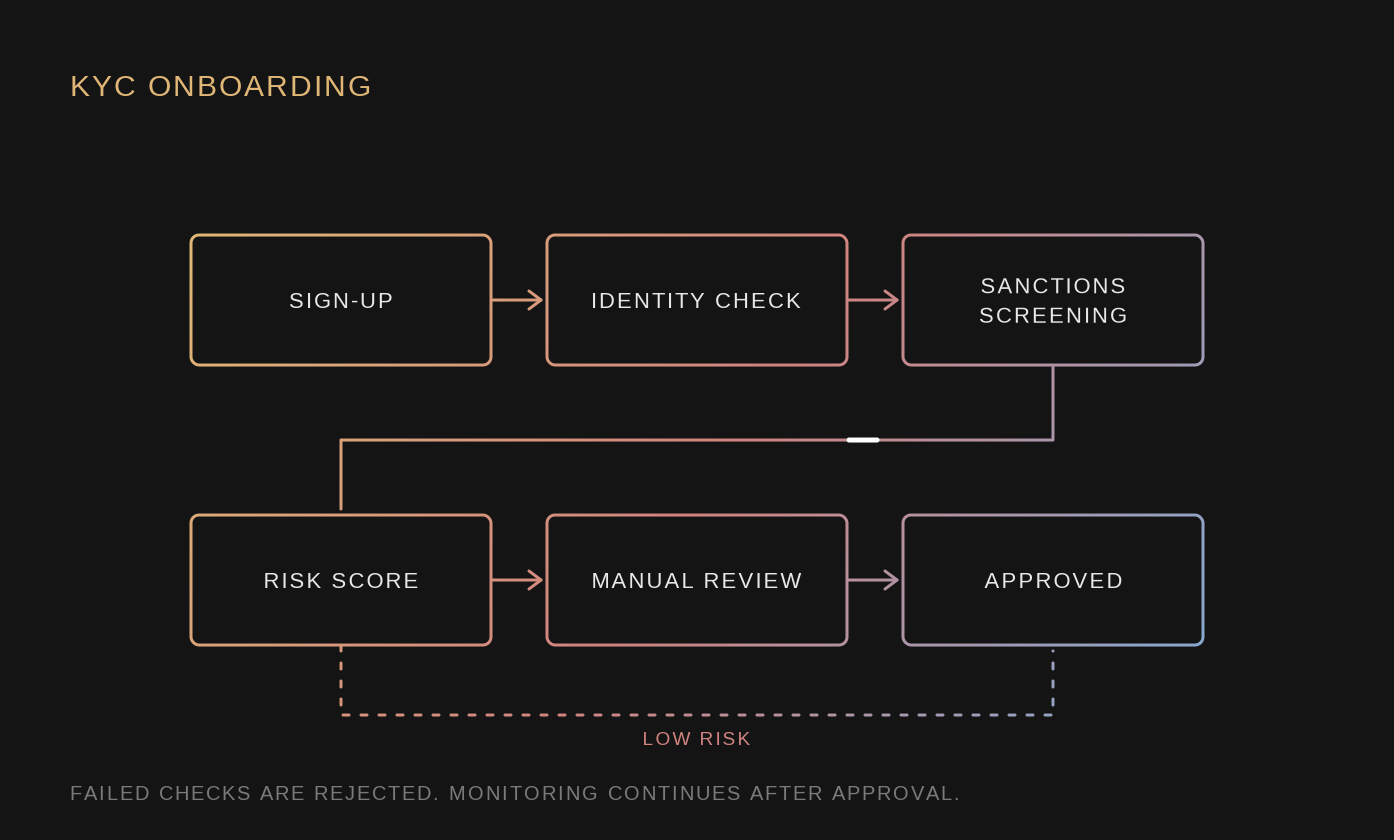
Use specialist providers, own the logic. Identity checks and sanctions screening are best bought, not built. But the rules about what a customer can do in each state belong in your system. If a provider changes, your product should not.
Monitoring never stops. Know your customer does not end at sign-up. Transactions are monitored for unusual patterns, and a customer can move from approved to restricted at any time. Every screen in the app has to know what to show a restricted user.
Data Protection by Design
A banking app holds some of the most sensitive data people have. We treat it accordingly.
- Collect only what you need. Every field you store is a field you have to protect, justify and eventually delete.
- Encrypt everywhere. In transit, at rest, and in backups.
- Least access. Engineers do not need production customer data to do their job. Support staff see only what the case in front of them requires.
- Plan for deletion and retention together. Data protection law says delete what you no longer need. Financial rules say keep certain records for years. The data model has to handle both.
Operational Resilience Is Part of the Design
UK regulators expect firms to know which services matter most to customers, how long each can be down before it causes real harm, and to prove they can recover within that time.
That is an infrastructure question. It shapes how we deploy, how we back up and restore, how we monitor, and how we handle the third parties the app depends on. A card provider or an identity service going down cannot take the whole app with it. Each dependency has a plan for what the app does when it is unavailable.
How Agents and Verification Let Us Move Fast
The other half of the three-month answer is how we work. We build with AI agents running in parallel, each on a small, scoped task. That gives us speed. What makes the speed safe in a regulated product is verification.
Checks decide, not the agent. Every change goes through automated tests and is checked against the real build before it can merge.
Risk decides who reviews. Anything that touches money, authentication, personal data or infrastructure is automatically high risk. It always goes to an engineer, and it is the code we read most carefully.
The foundation makes agents better. A clean ledger, clear onboarding states and one way of logging events give agents a codebase where the right move is obvious. That is the real link between compliance and speed. Good architecture is easier for regulators to trust and easier for agents to extend.
Security comes first in everything we build, and in fintech, traditional or blockchain, a single mistake can move real money. That is why we build these products the way we do. If you want a regulated product built quickly and properly, look at how we work on web and mobile apps.
Compliance Is How Fast Teams Stay Fast
The teams that struggle in fintech are not the ones with strict rules. They are the ones who discover the rules halfway through and have to rebuild the core.
Design the ledger, the audit trail, authentication, onboarding and resilience first. Everything after that is just features.