From Idea to Launch: The Six Steps Behind Every Product We Build

From idea to launch in six steps: discovery, architecture and planning, UX design, development, test and launch, scale and support. What each gives a founder.
Every founder who talks to a studio hears some version of the same promise. We will understand your idea, design it well, build it properly and launch it on time.
The promise is easy to make. What matters is the process behind it, because that is what you are really buying.
Our process has six steps: Discovery, Architecture and Planning, UX Design, Development, Test and Launch, and Scale and Support. Every product we build goes through all six. Here is what happens in each one, and what you should expect from it as a founder.
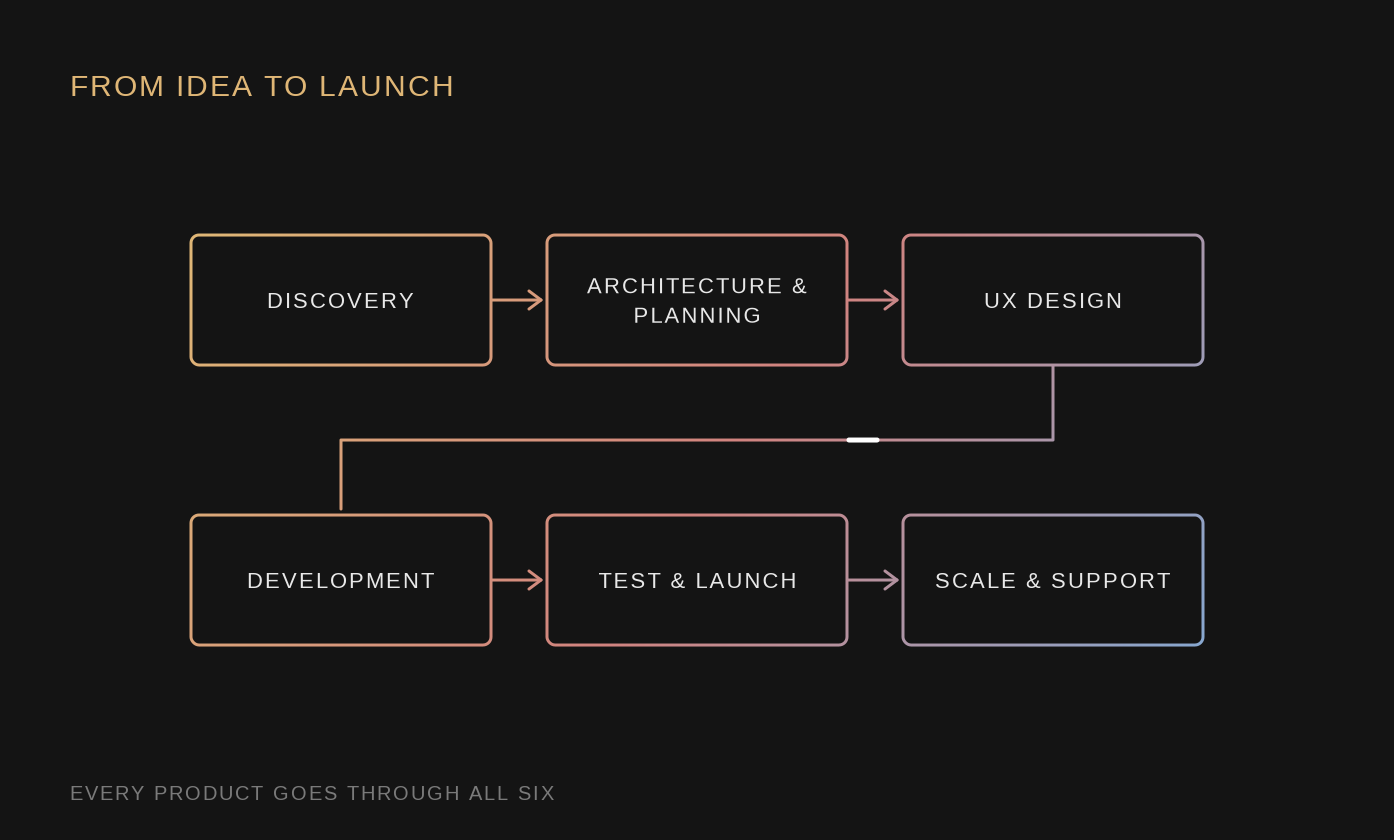
Step 1: Discovery, Before Any Code
Find the real problem first. In discovery we dig into your goals, your users and your market. The aim is to understand the problem worth solving, not just the feature list you came in with.
Turn an idea into a direction. Most products start as an idea that is part insight, part assumption. Discovery separates the two. By the end, you have a clear, validated direction before a single line of code is written.
Why it matters to you. Code is the most expensive place to discover that an assumption was wrong. A few weeks spent asking hard questions early is cheaper than a few months building the wrong thing.
A good discovery phase should leave you with fewer features than you started with, not more. If a studio agrees with every idea in your first meeting, it has not done discovery yet.
Step 2: Architecture and Planning
Choose the foundation on purpose. Here we map the technical foundation and the project roadmap. That means the stack, the structure of the system and the milestones along the way.
Plan for the product you will have, not just the one you launch. A good architecture lets development run smoothly, scale cleanly, and stay on time and on budget. It also makes the next feature cheaper to add, which matters more than most founders expect.
Our own product, Totebot, is a good example. It is an AI shopping agent platform for e-commerce, and a key architecture decision was to put an abstraction layer between the product and the AI providers. Today it supports 15 models across OpenAI, Anthropic and Google behind that one layer. Switching or testing models is a configuration choice, not a rewrite. You can read more in the Totebot case study.
Be honest about risk. This is also where we tell you what we think could go wrong. One of our values is simple: we don't hide risks, and we estimate realistically. A plan that looks perfect on paper usually hides something.
Step 3: UX Design
Design the journey, not just the screens. We create user journeys: how someone finds the product, what they are trying to do, and where they might get stuck. The interface designs follow from those journeys.
Balance function and feel. Good design is easy to use first and pleasant to use second. We aim for both, with clean interfaces that make the product feel obvious to the people who use it.
Design is where changes are cheap. Moving a button in a design file takes minutes. Moving it after it is built, tested and connected to a backend takes much longer. This is the step to change your mind freely.
We think beyond code, about the people who will actually use what we build. If you want to see what that work looks like day to day, we wrote about what a UI/UX designer does on our team.
Step 4: Development in Focused Iterations
Build in small, visible pieces. We build with clean, maintainable code and modern frameworks, in focused iterations. Each iteration is a chance for you to see progress and react to it.
Keep you in the loop. You are involved throughout, not just at the start and the end. We communicate often, and your feedback shapes what comes next. That way what we ship matches what you need, not what someone remembered from a kickoff meeting months ago.
Clean code is a business decision. Code that is hard to read is slow to change. Every shortcut taken to hit a date makes the next feature take longer. Quality over shortcuts is one of our values for exactly this reason: we build for the long term, not quick patches.
Step 5: Test and Launch
Test what can actually break. Before launch we test for performance, security and edge cases. Edge cases are where real users live: the slow connection, the expired session, the payment that fails halfway through.
Security is not a final checkbox. For products that move money or hold user data, a security problem is not a bug to fix later. It is the kind of mistake that ends trust in a product. That is why it sits on the testing list right next to performance.
Launch is an engineering task too. We handle the deployment, so your product goes live stable, polished and ready for real users from day one. A good launch is a quiet one.
Step 6: Scale and Support After Launch
Launch is the start, not the finish. Real users show you things no test can. After launch we keep the product running and growing: monitoring, maintaining and improving it.
Add features as the business learns. Once people use the product, you will learn what they actually want. Support means turning that into new features without slowing the product down.
Scale the infrastructure with the users. Systems that work well for a hundred users do not always work for a hundred thousand. An NFT marketplace we built is the example we know best. We built the first version on TheGraph, a hosted indexing platform, because it was the fastest way to launch. Over time, it made it hard to react to events from our own backend, reindex specific collections or block certain NFTs in real time. So we moved to our own custom indexers, which we now run for all our projects. We describe that change in the tech side of NFT marketplaces.
That is what scaling looks like in practice. The right choice for launch is not always the right choice a year later, and a good partner plans for both.
What to Look for When Choosing a Studio

Most studios will describe a process that sounds like this one. The difference is in how seriously each step is taken. A few signs to watch for:
They ask more than they promise. In the first conversations, a good partner asks about your users, your market and your constraints before talking about features or timelines.
They name the risks. If nobody mentions what could go wrong, it has not been thought about yet.
You see working software early. Focused iterations mean you should see real progress regularly, not a big reveal at the end.
They plan for after launch. Ask who will monitor the product, fix issues and add features once real users arrive. If the answer is vague, the plan ends at launch.
Six Steps, One Goal
Our mission is to help founders and teams turn ideas into scalable digital products, using AI and blockchain where they make sense. The six steps are how we do it.
Skip discovery and you build the wrong thing. Skip architecture and you rebuild it later. Skip design and users struggle. Skip testing and they find your bugs for you. Skip support and the product stops growing.
Each step protects the next one. That is the whole point of a process: not paperwork, but fewer expensive surprises between your idea and the people who will use it.