How Crypto Companies Get Hacked (It's Rarely the Smart Contract)

Most crypto hacks start with stolen keys, fake signing screens, fake hires and poisoned packages. Here is how they happen and how we defend against them.
When people picture a crypto hack, they picture a clever bug in a smart contract. Those still happen. But the biggest losses of the last few years started somewhere much more ordinary: a developer's laptop, a signing screen, a job interview, a package update.
We have built wallets, marketplaces, smart contracts and indexers for Web3 products for years. This post covers how crypto companies actually get hacked, and what we do on our own projects to make it harder.
The Largest Crypto Hack Started on a Laptop
In February 2025, attackers took about $1.5 billion from Bybit's Ethereum cold wallet, the largest crypto theft on record. The FBI attributed it to North Korean hackers.
The smart contracts worked exactly as designed. The wallet was a multisig, so several people had to approve every transaction. The attackers broke into a developer's machine at the wallet provider and changed the code of its web interface. When Bybit's signers approved what looked like a routine transfer, they were actually signing a transaction that handed control of the wallet to the attackers.
Every signer did their job. They looked at the screen, saw the expected address and approved. The screen was lying.
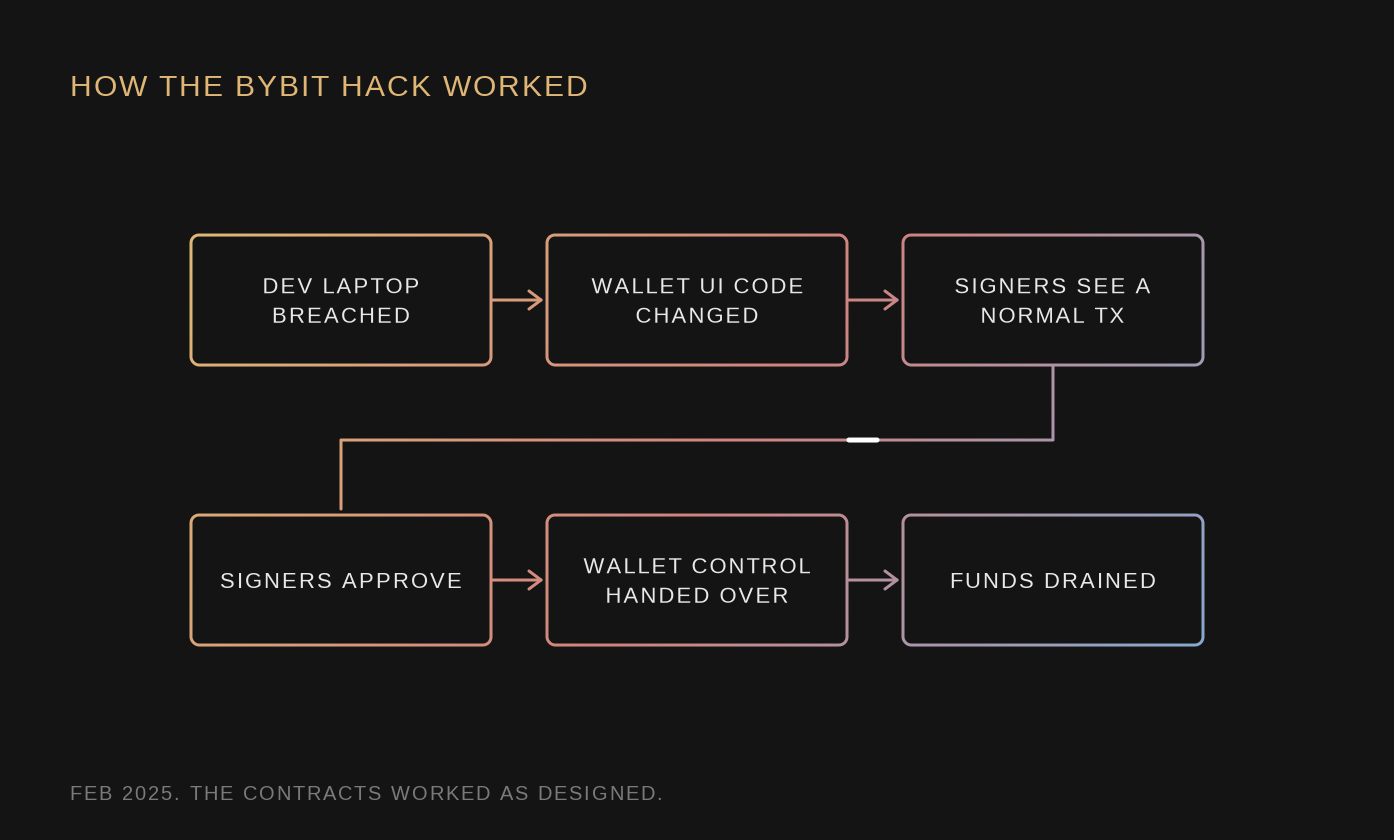
That is the pattern behind most large losses. The attacker does not break the lock. They get someone with a key to open the door.
Stolen Keys and Compromised Signing Flows
Private keys are the whole game. Whoever holds the key owns the funds. Keys end up in places they should never be: a server's environment file, a CI secret, a password manager shared by the whole team. Once a key is copied, there is nothing left to defend.
Blind signing turns approvals into guesses. Hardware wallets often show a hash or raw data that no person can read. So signers trust what the web page on their computer tells them. If that page is compromised, the hardware wallet faithfully signs whatever the attacker wants.
Front ends are part of the attack surface. A hijacked domain, a changed file in a storage bucket or an injected script is enough. Users connect their wallets and sign whatever the page asks, because the page looks exactly like it did yesterday. If you want a refresher on how transactions and signatures work, our Ethereum transactions 101 covers the basics.
Phishing Approvals Drain Wallets Without Stealing Keys
Many drains never touch a private key. The victim simply signs something.
A token approval gives another address permission to move your tokens. A permit signature does the same thing off-chain, for free, with no transaction on screen. To a user, both look like a harmless "Sign" button. To a drainer, they are a blank cheque.
We know this mechanism well because we use it legitimately. On an NFT marketplace we built, listings, offers and bids are off-chain signatures that users create without paying gas. The same type of signature that powers a gasless listing is what a phishing site asks you to sign. The difference is only in what the message says, which is why showing it in plain language matters so much.
For end users, the basics still apply: separate wallets for holding and for trading, hardware wallets for anything valuable, and a habit of revoking old approvals. We covered these in Staying safe in Web3 and Crypto wallet 101.
Fake Candidates and Social Engineering
Some attackers do not hack their way in. They apply for a job.
North Korean IT workers have spent years applying for remote engineering roles under false identities, often at crypto companies. Once hired, they get exactly what an attacker wants: access to the code, the deployment pipeline and sometimes the keys. Some do real work for months before anything happens.
The reverse also happens. Fake recruiters contact developers with a job offer and a "take-home assignment" that installs malware the moment it runs. The target is not the developer's salary. It is the access their laptop has.
We have always preferred to meet candidates in person, and our hiring process is built around talking through code the candidate wrote. Today that is a security control as much as a hiring one.
Supply-Chain Attacks on Your Dependencies
A modern Web3 front end pulls in hundreds of packages, and every one of them runs in your users' browsers.
In September 2025, a maintainer of some of the most widely used JavaScript packages fell for a phishing email. Attackers published malicious versions of packages like chalk and debug, which together see billions of downloads a week. The code sat quietly in the browser and swapped crypto addresses during transfers.
Nobody at the affected companies wrote a bad line of code. They just installed an update.
What We Do on Our Projects
Keys never live in one place. Treasury and admin roles sit behind a multisig or MPC wallet, so no single person, laptop or server can move funds alone. Signers use hardware wallets. Deployer keys have no lasting power after deployment, and hot wallets hold only what daily operations need.
Every transaction is simulated and shown in plain language. Before anyone signs, the transaction is simulated and decoded into something a person can read: "This changes the owner of the wallet to this address." For multisig, at least one signer checks the transaction on an independent tool, not on the same web page that proposed it.
Least privilege for contracts and for people. Admin powers are split into separate roles. Upgrades go through a timelock, so there is time to react. People get access to the projects they work on, with hardware security keys, and lose it when the work ends.
Dependency hygiene. Lockfiles, pinned versions, and no blind updates on the day a new version ships. We keep dependencies to a minimum, review what changes in the ones we update, and restrict which scripts a front end is allowed to load.
Security-sensitive code always gets a human. In our review process, any change that touches keys, signing, smart contracts or payments is high risk by default. It is read by an engineer, no matter how small it looks.
Hiring checks. Video with the camera on, in person whenever possible, verified identity, real references, and access that grows with trust instead of arriving on day one.
An incident plan before you need it. Who can pause the contracts, who contacts exchanges and stablecoin issuers to freeze stolen funds, and who talks to users. In a hack, the first hour decides how much you get back. That is not the time to work out who has which password.
If you are building a Web3 product and want this set up from the start, our blockchain team does it as part of every project.
Audits Are Necessary, Not Sufficient
Smart contract audits still matter. We recommend an independent audit to every client launching contracts that hold value.
But an audit checks the code, not the people, laptops, screens and packages around it. That is where most money is lost. Secure the code, then secure everything that touches it.